By Rebecca Butler
First-year teachers in Texas have been struggling to overcome work and pandemic-related stress. The hours once spent in in-person classes and professional development shifted to Zoom calls virtually overnight, creating a rocky start to their first year in the classroom.
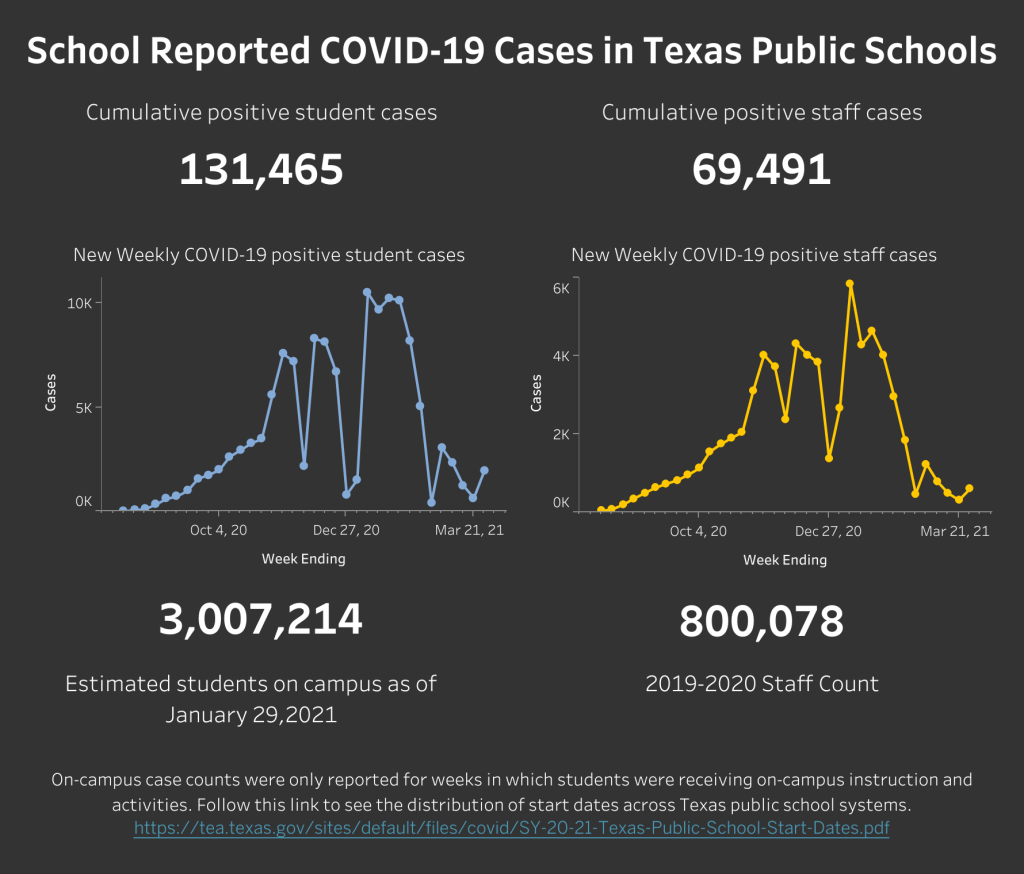
According to a report by the Texas Department of State Health Services, more than 69,000 staff members in Texas public schools have reported testing positive for COVID-19. Teachers attend college to learn how to teach in best-case scenarios, but no university could have prepared the class of 2020 to enter the profession during a global pandemic.
From The Classroom to The Playground
Among the teachers who graduated in 2020 was 23-year-old Alexandria Wojenski, a third grade math teacher at Madisonville ISD in Madisonville, Texas. She is also working on her master’s degree in education at Sam Houston State University. Like many graduates in 2020, she did not have an in-person commencement.
“How was I supposed to feel while looking for a teaching job when I never walked the stage and felt like my degree wasn’t real?” she said.
Once Wojenski found a job at Madisonville, she encountered a new set of challenges. She struggled to balance in-person and online classes after the district adopted an asynchronous learning model for the 2020–21 school year. Most of her students returned to the classroom by midsemester.
“We had very few students in the online program, so we had teachers spending an average of 13 hours a week on this curriculum that was only to be seen by one or two students,” she said.
Smaller districts faced difficulty providing technology to students due to limited funding, and teachers worked to fill the gaps as best they could. Wojenski says the difference between her expectations from college and the reality of teaching during a pandemic took a toll on her mental health and her relationships with coworkers.
“Though, no matter how hard it gets, I won’t give up. It’s all for the kids,” she said.
She recalled a moment when a student asked to play with another child during recess because it was the classmate’s birthday. Wojenski had to say no because students from different classes were not allowed to intermingle.
She remembers that moment as the first time she realized her job might look like this indefinitely. Still, she says she knows she chose the right profession.
Student Teaching and Sanitization
Kaylyn Contreras, a student teacher from Sam Houston State University, works in special education at New Waverly ISD. New Waverly, a small district south of Huntsville, has 1,021 students. Contreras says the district’s small size made the spread of the coronavirus easier to control.
With a mask policy and strict sanitization process, the district has seen a sharp decline in student illnesses, from common colds to COVID-19. Still, Contreras says her career expectations have been upended. She observes special education classes taught both virtually and in person and struggles with the technology required to teach online.
“My district did have training, but I wasn’t student teaching for the district yet,” she said. “I am pretty bad with technology, so I wish I would have had the opportunity to learn. We never used this stuff in college, so I didn’t even know these programs existed.”
Contreras believes technology has been the source of most of her stress. On top of that, she worries about staying safe.
She hopes the decrease in cases continues so that things will get easier in her community. For now, she follows the district’s mandatory mask rule and sanitization protocol.
Veteran Teachers’ Advice
Veteran teachers say experience has helped them adapt to the rapid changes. Carrie Vicars, a special education teacher at Cedar Ridge High School in Round Rock ISD, has taught for 20 years. She says she has never felt more supported by a district. Round Rock ISD, an Austin-area district with more than 51,000 students, has implemented distancing regulations and provided flexibility in learning formats.
Vicars said the district has “virtually stopped” the spread of the virus on her campus.
“Teaching children and teenagers is hard enough, and it is so scary to have your students walk into your room on the first day and have to introduce yourself,” she said. She can’t imagine managing the added stress of worrying about a microphone working during a first year of teaching.
Her advice for first-year teachers: trust your instincts, stay organized, and allow yourself to feel stressed when things get overwhelming. And most importantly, she said, “Use Google if you’re not sure about something having to do with technology.”
Christine Herbert, a math teacher at Hempstead High School in Hempstead, has more than 20 years of experience. She agrees that this year has been especially difficult for new teachers.
“I would just recommend that these teachers always stay flexible and ready for the challenge that this life and profession will throw at you,” she said.
Hempstead High School Assistant Principal Robert Thomas, also a veteran teacher, shared how his district has tried to support staff.
Thomas said his district has implemented many practices and protocols to ensure the teachers and staff are safe and healthy, like mandatory reporting, mask-wearing, and close-contact tracing. He also said they offered mental health services to teachers, staff, and students.
“The most effective way to maintain our district ratings is to put our kids and staff first,” he said
 Rebecca Butler
Leave a comment